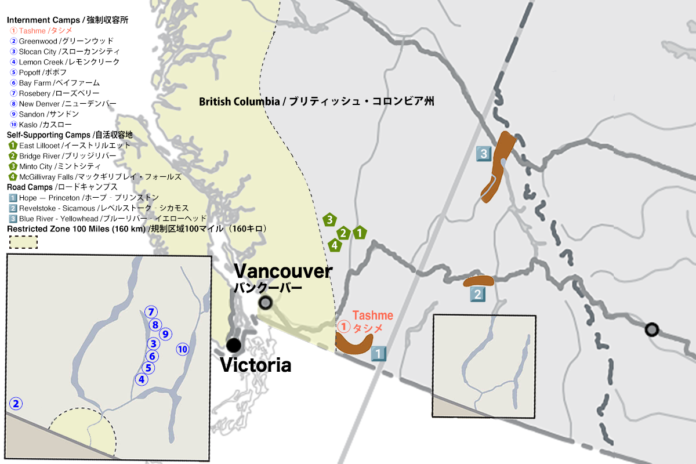
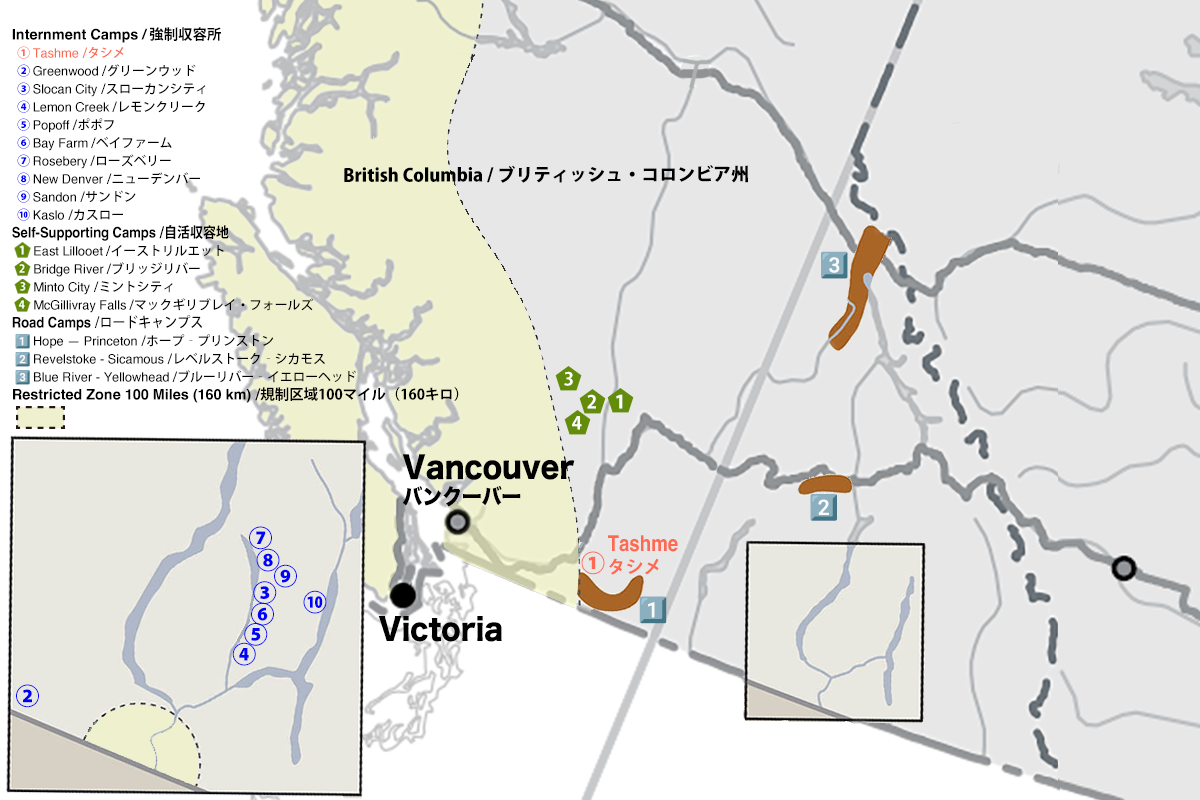
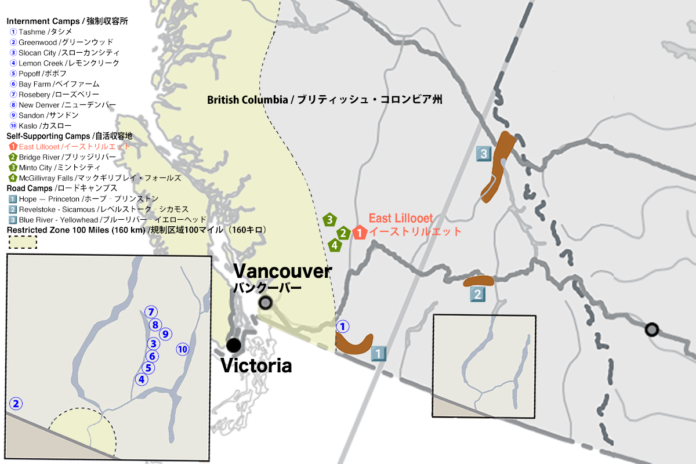
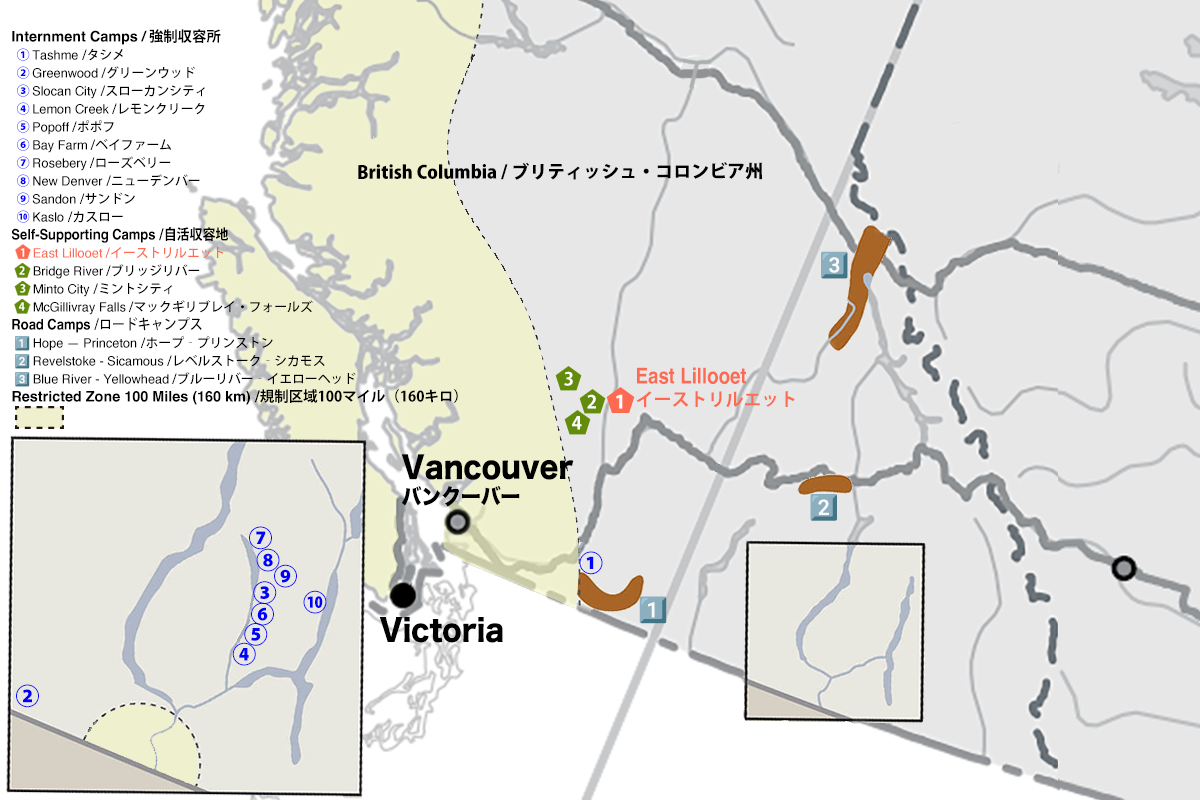
In February 1942, the federal government decided to set up four major road building camps (referred to as “road camps”) in British Columbia, Alberta, and Ontario. The camps were set up in three locations in British Columbia—Hope-Princeton, Revelstoke-Sicamous, and Blue River-Yellowhead—and one in Ontario, Jackfish-Schreiber. Among these, the three camps in British Columbia were considered to be a priority for national security reasons.
Japanese Canadian men forcibly relocated from coastal areas of British Columbia were sent to these three road camps.
Hope-Princeton Road Camp
The Hope-Princeton Road Camp was established to construct a 133-kilometre road connecting Hope and Princeton. Among the three road camps in British Columbia, it was the closest to the “protected area,” and the families of those men were housed nearby in the Tashme internment camp.
Revelstoke-Sicamous Road Camp
The Revelstoke-Sicamous Road Camp was set up for highway construction between Revelstoke and Sicamous. Approximately 500 Japanese Canadian men were sent to this camp. They worked on developing, improving, and reconstructing a 44.5-mile (approximately 71.6 kilometres) section of the Trans-Canada Highway west of Revelstoke for two years and four months.
Blue River-Yellowhead Road Camp
The Blue River-Yellowhead Road Camp, located near the Alberta border, began operations in February 1942. Its purpose was to construct a highway connecting British Columbia and Alberta. At its peak in 1942, around 1,500 Japanese Canadian men worked here. However, by May 1946, only 35 workers remained.
East Lillooet, Bridge River, Minto, and McGillivray Falls, located in the mountainous regions of British Columbia (BC), were designated as “self-supporting camps” for the internment of Japanese Canadians. These camps did not receive any government funding.
In these internment camps, leaving the premises was strictly prohibited. Due to the harsh living conditions in the mountainous geography, the internees were forced to live self-sufficiently, facing challenges like resource shortages and extreme cold.
East Lillooet
East Lillooet was the largest self-supporting camp in the Lillooet area, located approximately 250 kilometres northeast of Vancouver. Situated upstream along the Fraser River, the camp housed over 300 individuals.
The living conditions were extremely harsh. Residents had to build their own shelters, lived without electricity, and endured severe winter cold. Initially, water had to be hauled from the Fraser River, stored in tanks, and filtered before use, creating significant inconvenience. Despite these challenges, Japanese Canadians relied on limited resources and led lives centred around agricultural activities.
Bridge River
The Bridge River camp was a self-supporting settlement established in the remnants of an abandoned gold mining and hydroelectric project site. Japanese Canadians were forced to live in shacks previously used by labourers and left vacant for years. They sustained themselves primarily through agricultural efforts.
Minto
Minto was an isolated area that had once thrived as a mining town but had been abandoned by wartime due to the closure of many mines. Its remote location made it an especially challenging place to live compared to other camps.
McGillivray Falls
McGillivray Falls was located just outside the 100-mile “protected area” (approximately 160 kilometres). Japanese Canadians there were employed at a sawmill near D’Arcy, a town within the protected area.
Greenwood is known as the first town in Canada to take a proactive stance in accepting Japanese Canadians who were interned during World War II.
Grand Forks, however, served as a “self-supporting site” where families worked together to rebuild their lives.
Greenwood
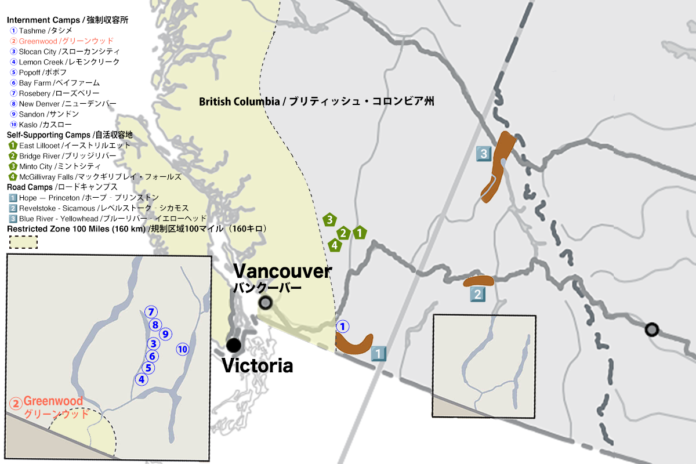
Greenwood was one of the Japanese Canadian internment sites supported by the Canadian government. In 1942, when the internment began, most towns rejected the arrival of Japanese Canadians. However, Greenwood welcomed them.
At that time, Greenwood’s population had dwindled to about 200 people, and the town faced the risk of decline. Mayor W.E. MacArthur Sr. publicly declared in a newspaper advertisement that the town would not refuse Japanese Canadians. This statement became a catalyst for their relocation to Greenwood as a new place of residence.
Key figures in relocating Japanese Canadians included Father Benedict Quigley of the Catholic Church and Franciscan nuns, who played significant roles in supporting the community.
In 1945, the Canadian government forced Japanese Canadians to choose one of two options: move east of the Rockies or “repatriate” to Japan. However, in Greenwood, the city hall and the Chamber of Commerce submitted protests to the government to allow Japanese Canadians to stay in the region. As a result, hundreds of Japanese Canadians remained in Greenwood and built new lives. Greenwood became one of the few communities that continued to provide a life foundation for Japanese Canadians after the war.
Grand Forks
Grand Forks is located approximately 40 kilometres east of Greenwood. Beginning in 1939, under the leadership of Reverend Esumatsu Nakatani, Japanese Canadians voluntarily established a foundation for their lives, making Grand Forks one of the “self-supporting relocation sites.” Over 300 people relocated there.
Cooperating with nearby towns such as Greenwood and Midway, the community made an effort to support Japanese Canadians in establishing their livelihoods.
In the West Kootenay region of south-central British Columbia (BC), the Canadian government established eight government-supported internment camps. Among these, New Denver and Rosebery were located along the eastern side of Slocan Lake, Sandon lay in the mountainous region, and Kaslo was located on the western shore of Kootenay Lake.
These towns had briefly thrived during the mining boom of the early 20th century. Still, they became ghost towns following the decline of the mining industry.
When the Canadian government initiated the internment of Japanese Canadians, the existing infrastructure in this region was repurposed to establish internment sites.
New Denver
In 1942, Japanese Canadians arrived in New Denver, and at its peak, approximately 1,505 people were interned. It was the third-largest internment site in the province in 1942. Later, New Denver became a center for healthcare and welfare, including establishing a tuberculosis sanatorium.
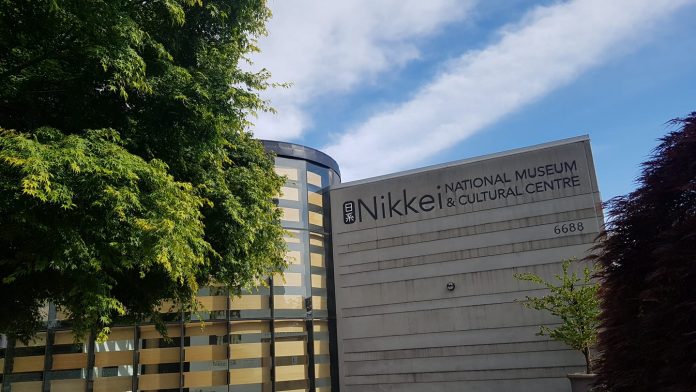
After World War II ended, many internment sites were closed, but the Japanese Canadian community in New Denver remained. Today, this site is home to the Nikkei Internment Memorial Centre (NIMC), which preserves and shares the history of Japanese Canadian internment.
Rosebery
Located about 4 kilometres north of New Denver, Rosebery housed approximately 365 people. Known as a satellite camp of New Denver, the living conditions there were also harsh. Today, the site of the former internment camp is preserved as a historical heritage site.
Sandon
Once a bustling mining hub, Sandon was repurposed as an internment site in 1942, housing approximately 953 people, many of whom were Buddhists. However, the site proved incredibly challenging due to its remote, mountainous location, limited sunlight and harsh winter conditions. The Japanese Canadians were eventually relocated to New Denver, making Sandon the first internment camp to close.
Kaslo
Kaslo, which had previously declined, became a town with about 1,200 internees. The Japanese Canadians worked to improve their living conditions by renovating aging buildings and constructing Japanese-style baths.
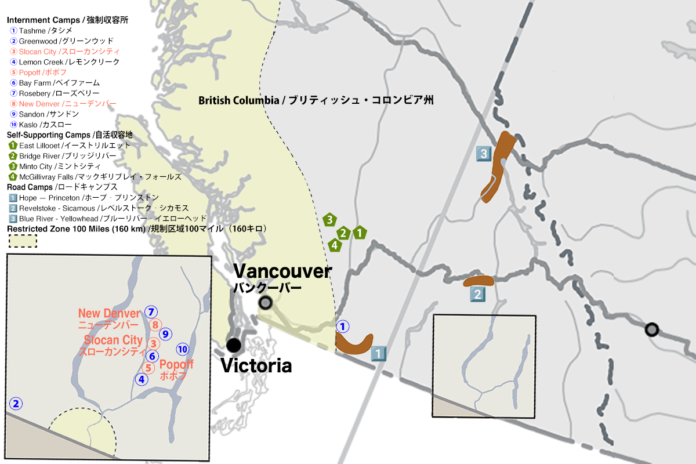
In the West Kootenay region of south-central British Columbia (BC), the Canadian government established eight government-supported internment camps. Four were Slocan City, Lemon Creek, Popoff, and Bay Farm, located south of Slocan Lake.
Slocan City
Approximately 595 individuals were interned in Slocan City. Their accommodations included old hotels, buildings, and miners’ lodges, where they lived under limited and challenging conditions.
This site also served as the departure point for many Japanese Canadians who were “repatriated” to Japan in 1946. Today, the Japanese Cemetery Monument in Slocan City stands as a legacy that preserves memories of that era.
Lemon Creek
Lemon Creek, located about 8 kilometres south of Slocan City, was the largest internment site in the Slocan Valley. Over 1,851 Japanese Canadians were detained there.
The internees were made to engage in labour, such as cutting railway ties. The camp operated between 1942 and 1943 and was closed in 1946.
Popoff
The Popoff camp was established on a farm leased from Emily and Constantine Popoff. It was situated midway between Slocan City and Lemon Creek.
As the last camp to be built, it was completed in 1943 and housed approximately 1,000 people. The site was closed in 1946.
Bay Farm
Bay Farm, located south of Slocan City, accommodated 1,376 Japanese Canadians by the end of 1942.
Initially, internees lived in makeshift tents, later replaced by shacks. The extreme cold of winter posed severe hardships, and internees faced daily struggles to cope with the freezing temperatures.
Tashme was an internment camp established by the Canadian government in 1942 to detain Japanese Canadians. It was the largest of the government-supported internment camps in Canada.
The camp was located just outside the 100-mile (160-kilometre) “restricted zone” designated by the government. Spanning approximately 1,200 acres, the camp housed up to 2,644 people at its peak.
The land used for the camp was originally a dairy and livestock farm known as “Fourteen Mile Ranch.” The government leased the property from its owner and converted it into an internment camp starting in July 1942.
The first detainees arrived on September 8, 1942, from Hastings Park in Vancouver, a temporary holding area for Japanese Canadians. They were transported in groups of 150 via train and bus.
The site for the Tashme Internment Camp was initially chosen to accommodate 500 families, primarily consisting of men aged 18 to 45 who had been separated from their families and living in roadside camps while working on the Hope-Princeton Highway construction. However, as the camp construction required labour, these men were allowed to reunite with their families. This necessitated the rapid expansion of housing, leading to the development of the Tashme camp.
Construction progressed swiftly due to the urgency of the internment process, and by December 1942, 347 housing units had been completed.
Closure in 1946 and Government Policy on Eastern Relocation
Despite the end of World War II in August 1945, the Canadian government forced Japanese Canadians to choose between relocating east of the Rockies or “repatriating” to Japan. The residents of Tashme began to leave, and the camp was officially closed on August 12, 1946.
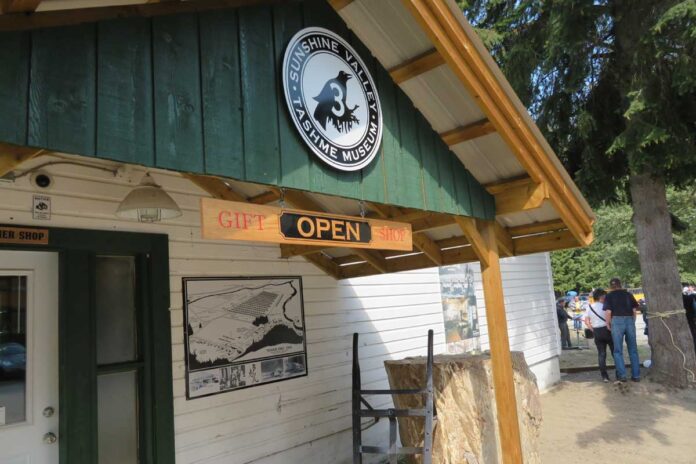
Today, Tashme is known as Sunshine Valley. The Tashme Museum and Memorial Center has been established there to preserve the memory of the internment era, with exhibits and monuments ensuring that this history is not forgotten.